
Fun Facts about Pine Ridge
Opossums: Top 10 Fascinating Facts
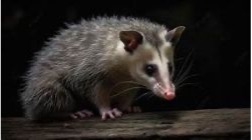
Did You Know?
Opossums: Top 10 Fascinating Facts
- Opossums are immune to snake venom. They can survive venomous snake bites thanks to a special protein in their blood!
- They eat thousands of ticks each season, helping to prevent tick-borne diseases.
- Diet: Opossums are natures pest control. They love munching on garden pests like slugs, beetles, crickets, and cockroaches without destroying your flowers or veggies. They don’t dig holes in your yard! They also eat fruits, veggies, small animals, and even carrion, adapting to various environments.
- They can climb! With a prehensile tail and opposable thumbs on their hind feet, they’re expert climbers.
- Opossums are not aggressive! When there is a threat of a predator, you or something else, they “play dead”. This is called thanatosis and this state can last from minutes to hours.
- Opossums have a short lifespan. They only live 2-3 years in the wild but make a big impact on their ecosystems in this short timeframe.
- They are solitary & nomadic; always on the move, and they don’t establish permanent dens.
- They have been around for a long time, estimated for over 70 million years, since the time of dinosaurs!
- Opossums are North America’s only marsupial. Female opossums carry and nurse their young in a pouch, just like kangaroos.
- They are almost totally immune from contracting rabies as their body temperature is too low for the virus to survive.
The next time you see an opossum, in Pine Ridge or elsewhere, remember these amazing facts and show them some love!
BLACK BEARS IN PINE RIDGE
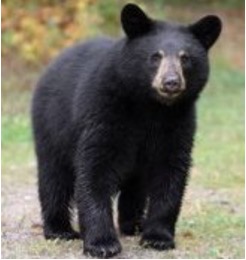
BLACK BEARS IN PINE RIDGE
Did you know that a BLACK BEAR was recently spotted in Pine Ridge?
Black bears are native to our area and are an important part of Florida’s heritage. They are naturally shy, timid animals that try to avoid people. However, as human development expands, it becomes increasingly difficult for bears to avoid people. Bears are lured into neighborhoods when they find an easily accessible food source. Think bird feeders or pet food left outside. Note: It is NOT legal to feed bears. They also pass through Pine Ridge neighborhoods when going from one State Forest or Wildlife Mngt area to another.
(Withlacoochee St. Forest//Flying Eagle Wildlife Mngt Area//Half Moon Wildlife Mngt Area//Potts Wildlife Mngt Area//Ross Prairie St. Park//Chassahowitzka Wildlife Mngt Area and Ocala National Forest {where most of FL black bears can be found})
A bear may climb a tree if it gets scared. Leave it alone and it will climb down and be on its way. Make noises when hiking in bear territory. Do not run from a bear, walk away slowly.
Florida bears don’t fully hibernate in winter but instead go into a state, called torpor.
A bear sighting in Pine Ridge is not common, but it can occur!
What is that weird colored stuff growing on my tree trunk?
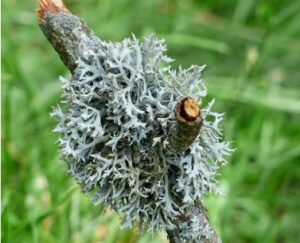
Many tree owners become concerned when they see odd, grayish green ‘growths’ on tree bark. These organisms are lichens, and they are a symbiotic combination of an algae and a fungus. They are completely harmless!
They can also be found on rocks and abandoned machinery. Oftentimes they prefer to live on dead branches. This gives the appearance that they are killing the tree — they are not! Many lichens will not grow in locations where the air is polluted, so they are a good indication of clean air!
The Sherman’s Fox Squirrel
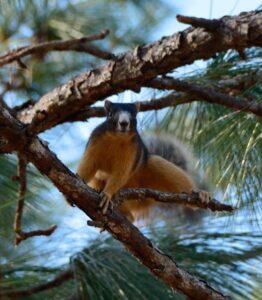
The Sherman’s Fox Squirrel is a native squirrel that can be found in north Florida and south Georgia regions. A particularly larger species of squirrel, they can weigh between one and three pounds. The defining feature of this squirrel is that its head is colored black, with the nose and ears being white. Although there can be variations – from all black to black and silver – most species will exhibit the aforementioned coloration.
You can most often find Sherman’s Fox Squirrels in areas that have longleaf pines and sandhill habitats. Their diet consists of fruit, nuts and seeds, with pine seeds being one of their favorites.